

See here details for the fascial movement routine:
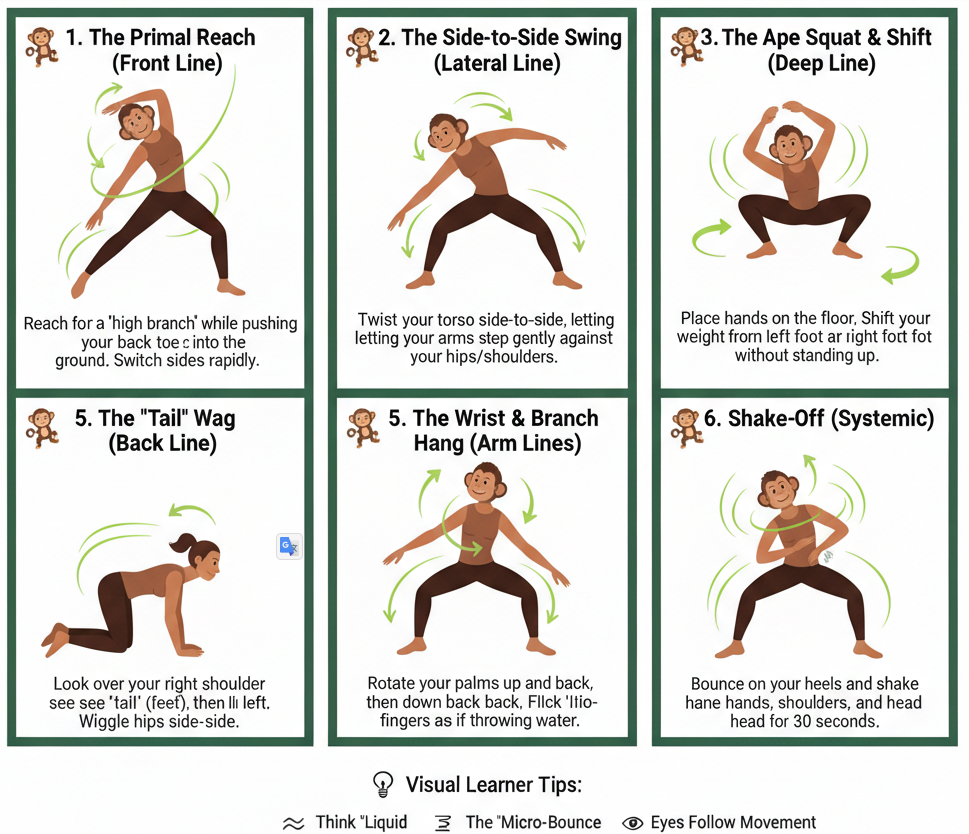
1. The Primal Reach (Front Line)
– Visual: Stand tall, reach one arm high and the opposite leg back.
– The Move: Reach for a “high branch” while pushing your back toe into the ground. Switch sides rapidly.
– Fascial Focus: Opens the chest, hip flexors, and the front of the throat.
2. The Side-to-Side Swing (Lateral Line)
– Visual: Feet wide, arms hanging loose like “wet noodles.”
– The Move: Twist your torso side-to-side, letting your arms slap gently against your hips/shoulders.
– Fascial Focus: Unsticks the ribs and releases the “wraparound” waist fascia.
3. The Ape Squat & Shift (Deep Line)
– Visual: A deep, low squat (go as low as comfortable).
– The Move: Place hands on the floor. Shift your weight from left foot to right foot without standing up.
– Fascial Focus: Opens the pelvic floor and the inner-thigh “adductor” chain.
4. The “Tail” Wag (Back Line)
– Visual: Hands and knees (Tabletop position).
– The Move: Look over your right shoulder to see your “tail” (feet), then your left. Wiggle your hips side-to-side.
– Fascial Focus: Loosens the lumbar fascia and the connections along the spine.
5. The Wrist & Branch Hang (Arm Lines)
– Visual: Standing, arms out like a “T” with fingers spread wide.
– The Move: Rotate your palms up and back, then down and back. Flick your fingers as if throwing water.
– Fascial Focus: Releases the fascia in the forearms and carpal tunnel area.
6. The Shake-Off (Systemic)
– Visual: Total body “vibration” or shivering.
– The Move: Bounce on your heels and shake your hands, shoulders, and head for 30 seconds.
– Fascial Focus: Resets the nervous system and “wakes up” the entire web.
